Pixel Tarot Blog
Tarot 101: The Suit of Swords
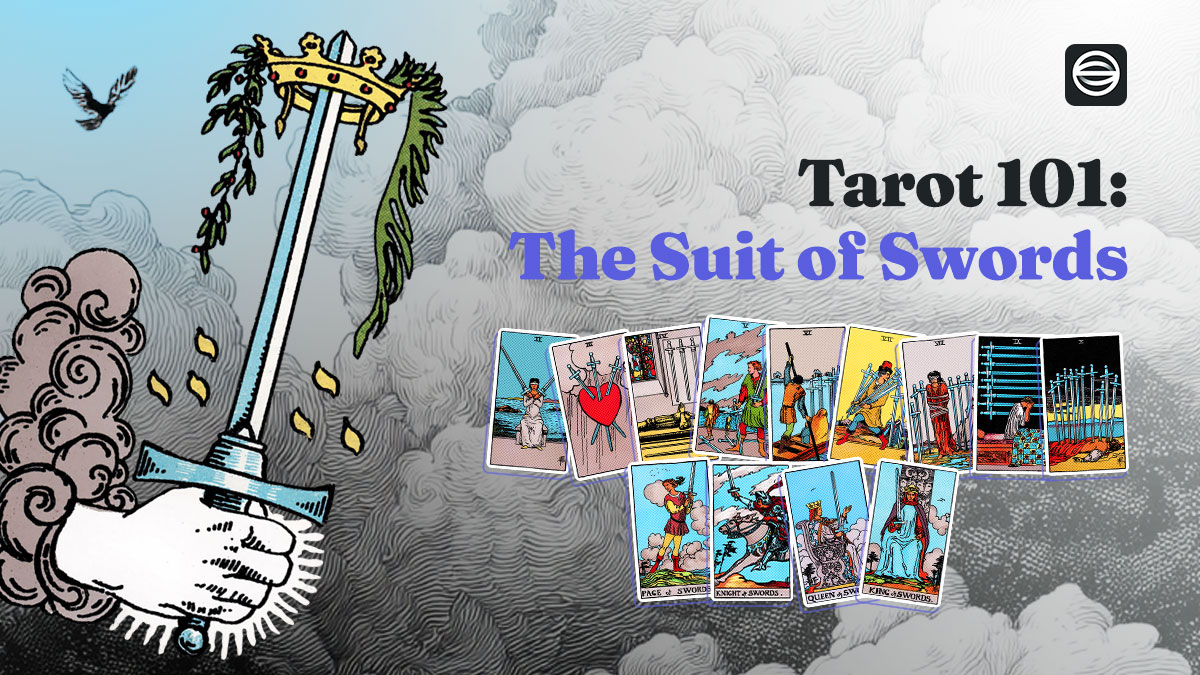
The Suit of Swords is Tarot’s conversation. It’s direct, sometimes uncomfortable, and impossible to ignore once it starts. These cards show up when something needs to be said, decided, clarified, or cut through.
Swords are about thinking, not feeling. They represent analysis, communication, beliefs, boundaries, and the stories we build around what’s happening. This suit reminds us that clarity doesn’t always feel gentle, and that growth often begins with a hard look at what’s true.
And as air can move quickly, so do thoughts. One sentence can change your mood. One assumption can reshape your entire day. The mind can steady you, or it can convince you that the sky is falling.
The suit of Swords just asks you to slow down just enough to examine what you’re thinking. Not every thought deserves authority and not every belief deserves to stay.
Swords: The Element of Air
 Air is constant. It doesn’t arrive the way fire does. It doesn’t pool like water or anchor like earth. It’s just... there. It surrounds you, fills your lungs, presses lightly against your skin. You rarely think about it until something changes.
A sudden gust. A change in temperature. A pressure drop before a storm.
And the mind works in a very similar way.
Most of the time, our thoughts hum quietly in the background. They narrate our day. They interpret what’s happening andassign meaning. And we don’t question them because they feel continuous, like background chatter we’ve learned to trust. But then something changes.
A comment lands differently. A realization snaps into place. An assumption starts looping. A memory resurfaces. Now you notice the air. And it feels different.
And while the Suit of Swords isn’t about feelings themselves, it’s impossible to separate it from the Suit of Cups. Thought and emotion constantly influence each other. Swords don’t describe what you feel as much as they describe the interpretation behind that feeling.
For example, imagine you receive a short text from someone you care about. It simply says, “Okay.” On its own, it’s neutral. Maybe even harmless. But depending on your mental state, that single word can become something else entirely.
Are they upset? Did I say something wrong? Are they pulling away? Why did they end with a period (are they being passive-aggressive)?
Now the sadness isn’t just about the message. It’s about the story forming around it. The mind fills in gaps. It assigns motive and begins to predict outcomes. The original feeling might have been mild disappointment. But once thought begins looping, it can turn into anxiety, insecurity, even anger.
The event didn’t change. The interpretation of what happened did.
The Sharpness of Air
But there's another aspect to the Suit of Swords and the element of air: sharpness.
Air is invisible, but it carries force. Wind can erode stone. It can strip branches bare. It can churn water into a violent force. It doesn’t need solidity to have impact. Our words function in much the same way.
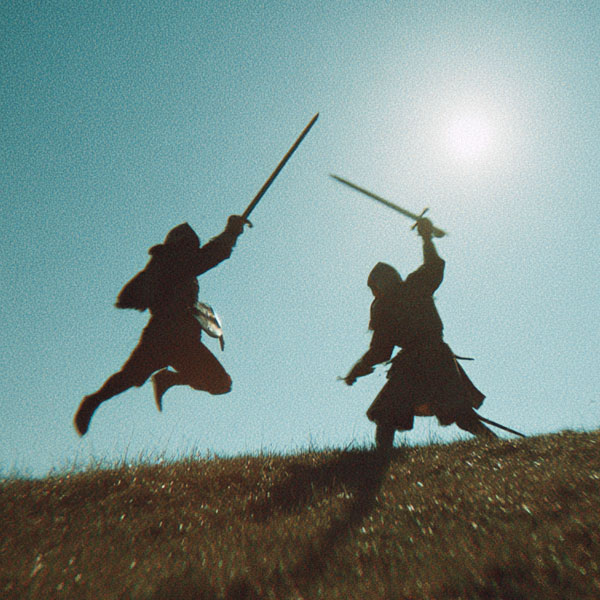 A sentence can give meaning to and support a relationship. But a single sentence can also end one. A belief repeated long enough can become a personal law, a guiding force in the world. But that same belief can also be used to limit others in an attempt to control and diminish. That duality is embedded in the image of the double-edged sword itself.
In movies and fairytales, the one who carries the sword can be the hero or the villain (or maybe even both, it's all a matter of opinion, I suppose). The blade can protect or wound. It can cut through danger or create it. The sword isn’t inherently moral one way or the other, but it is powerful.
That’s why the suit of Swords often carries images of tension or pain. Not because the element is cruel, but because clarity draws lines. When fog lifts, you see the world around you as it is. The drop-off. The distance. The direction forward. And once those lines are visible, they're pretty difficult to erase.
The Power of Definition
Air carries and delivers. It is the element of speech, thought, and definition. Through language, we sort our experience and draw lines between ideas. We decide what something is and what it is not. Air, itself, doesn’t create conflict; it creates clarity. It allows us to distinguish, define, and name. And once something is named, it becomes something we can understand.
Air draws quiet lines through the messiness of real-life experience. It helps us recognize what we are feeling, what we are thinking, and what we are assuming.
A Shift in Perspective
We often reduce Swords to conflict or stress, but that is only one expression of how the mind works. At its best, Air brings perspective. It lifts you above immediate reaction so you can see what is actually happening underneath. Instead of simply reacting, you begin to ask why. Why did I respond that way? What belief or assumption shaped my reaction? This is where Swords become constructive. They help us recognize conditioned learning, bias, prejudice, and inherited narratives so we can examine them consciously.
But the same clarity that allows insight can also become distortion. When perspective collapses inward, air loses its objectivity. At its worst, it circulates the same thought again, looping and looping and looping again until it builds pressure. It mistakes repetition for truth. It sharpens fear into false certainty.
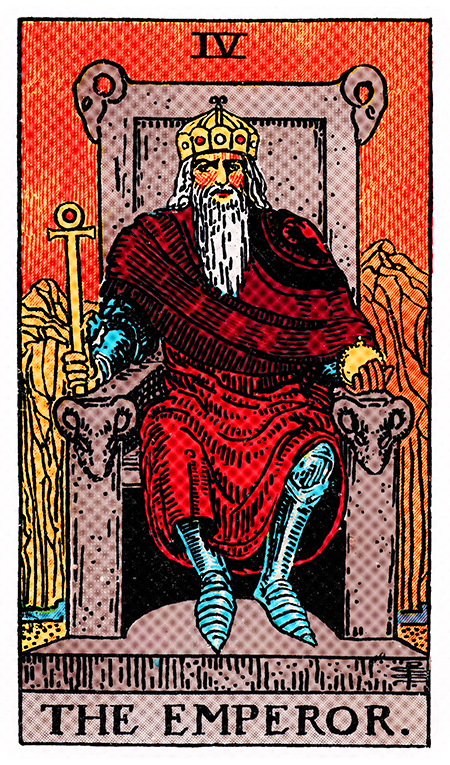 The Suit of Swords: Structure + The Emporer
In many traditional Tarot systems, The Emperor is associated with Fire because of his connection to Aries, a fire sign linked to leadership and initiative.
In this series, however, the elements are explored through how the cards behave psychologically. From that perspective, The Emperor reflects air: the force of structure, definition, and mental order.
When looking at The Fool's Journey, The Emperor is the fourth step on the way, full of "Dad" energy, teaching the effects of self-discipline, routine, organization, and personal stability.
Up until this point, the Journey has been instinctive and exploratory. The Fool leaps. The Magician initiates. The High Priestess observes. The Empress nurtures. And now - the Emperor draws lines and builds order.
He teaches that freedom without structure collapses. That inspiration without direction scatters. That emotion without boundaries overwhelms.
Structure is not restriction for its own sake. It is definition. It is clarity about what belongs and what does not. And as I mentioned before, the act of defining is deeply connected to the element of air.
These themes are present through out the Suit of Swords. We see struggles and resistance to structure throughout, and it becomes obvious that emotion, fluid like water, is not something that adheres to the blocky confines of structure. We see inner conflict seed, sprout, adn bloom as emotion pulls one way and the mind another.
A Look at the Cards
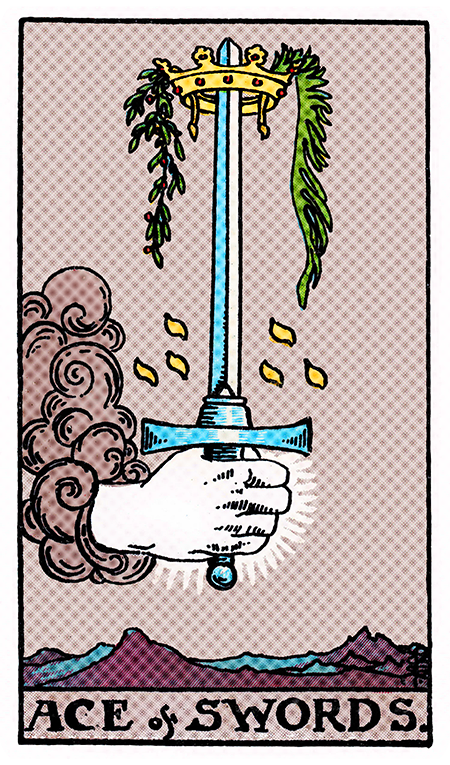 Ace of Swords
Air piercing. The Ace of Swords is that moment when something finally clicks. Not gently. Not politely. More like when you’ve been squinting at something blurry and someone wipes the glass clean without warning. Suddenly you see it. And once you see it, you can’t unsee it. This is the start of a conversation. Or the start of a decision. Or the beginning of admitting something you’ve been avoiding. It’s truth walking into the room and turning the lights on.
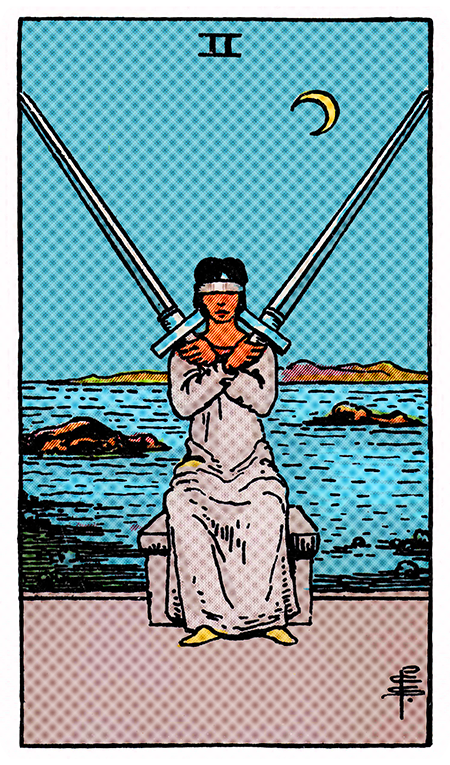 Two of Swords
Air divided. The Two of Swords is what happens when you know a decision is coming, but you’re pretending it isn’t. You’re holding two ideas in your hands like they’re equally weighted. You tell yourself you’re being neutral. Balanced. Thoughtful. But sometimes neutrality is really just procrastination. This is the pause before clarity. The tension of “I don’t want to choose. Please don't make me choose.” And the uncomfortable realization that not choosing is, in fact, a choice.
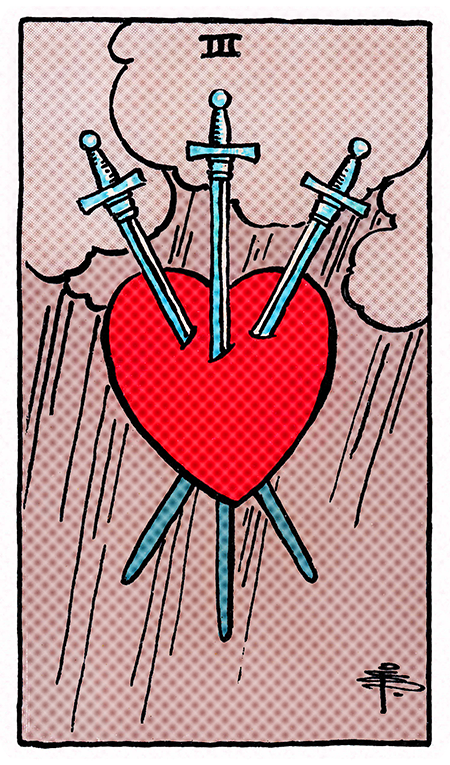 Three of Swords
Air wounding. The Three of Swords is the sting of understanding. It’s the moment reality interrupts the story you were telling yourself. Sometimes it’s words. Sometimes it’s betrayal. Sometimes it’s just the painful awareness that something isn’t what you hoped it was. It hurts because it’s precise and clear. And because it lands exactly where it needed to. And once you know, you know.
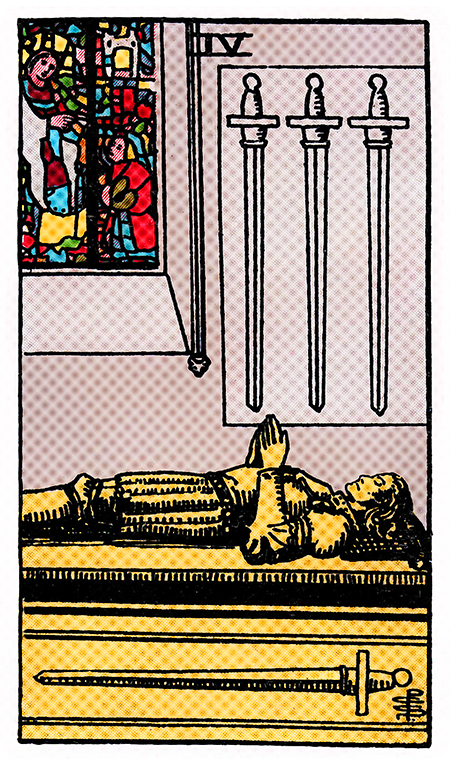 Four of Swords
Air stilled. After the storm of the Three, the Four says: lie down. Not forever. Just long enough. This is mental recovery. Letting your thoughts stop pacing like they’re training for a marathon. Silence and space become useful here. Not avoidanceor or suppression. Just space. Not every truth needs to be acted on immediately. Sometimes the bravest thing to do is just sit and let your nervous system catch up.
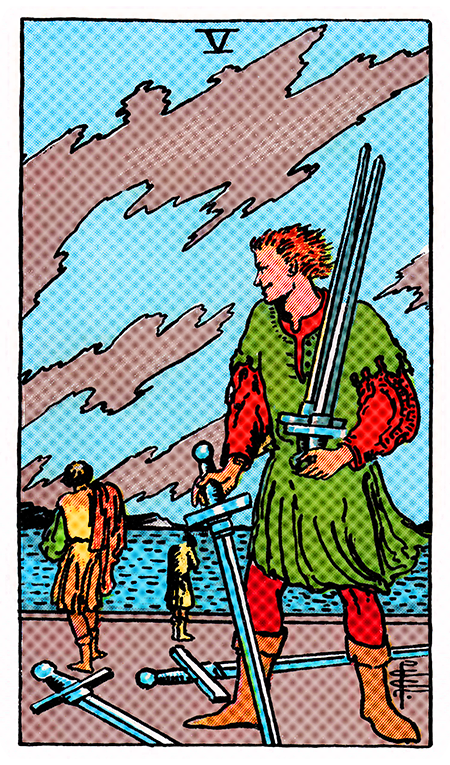 Five of Swords
Air distorted. The Five of Swords is what happens when being right becomes more important than being kind. You might “win.” But look around. You won, but at what cost? This is ego creeping into communication. This is defensiveness sharpening every word. Someone walks away feeling small. Sometimes you don't even realize it’s you. It’s the kind of conflict that leaves a weird aftertaste.
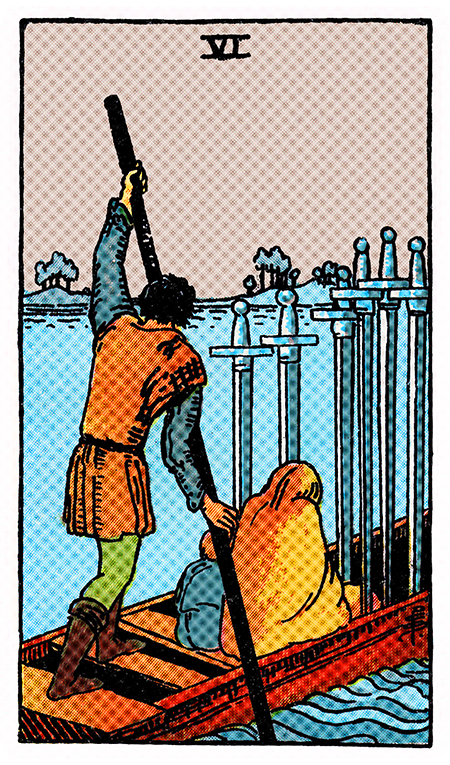 Six of Swords
Air transitioning. The Six of Swords is quieter than it looks. You’re not in the middle of the chaos anymore. You might still be tired. You might still feel the residue of whatever just happened. But at least you're moving. You may not feel relief yet, but you’re no longer drowning in the noise. Sometimes growth doesn’t feel triumphant. It just feels a little bit calmer. And also - who are you in this card? The person steering the boat or the passenger. This is where perspective comes in.
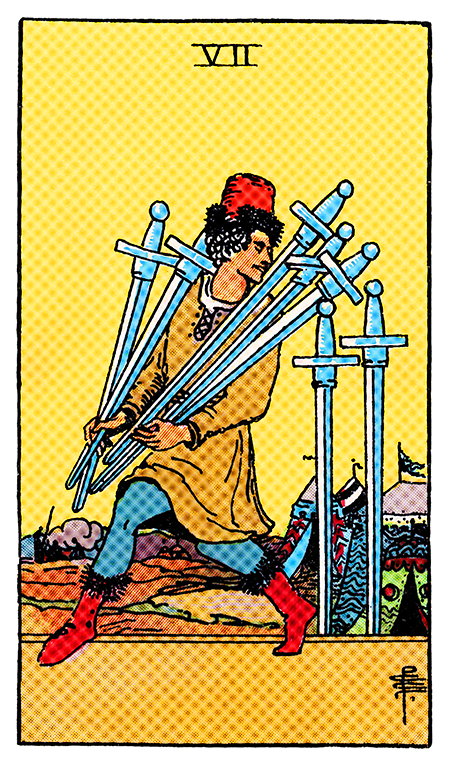 Seven of Swords
Air concealed. The Seven of Swords is strategy. Or sneakiness. Or self-deception wearing a cute hat. Something is being withheld. Maybe from someone else. Maybe from yourself. This card asks a slightly uncomfortable question:
What truth are you sidestepping? Sometimes it’s intelligent problem-solving. Sometimes it’s avoidance dressed up as intelligence. You usually know which one it is.
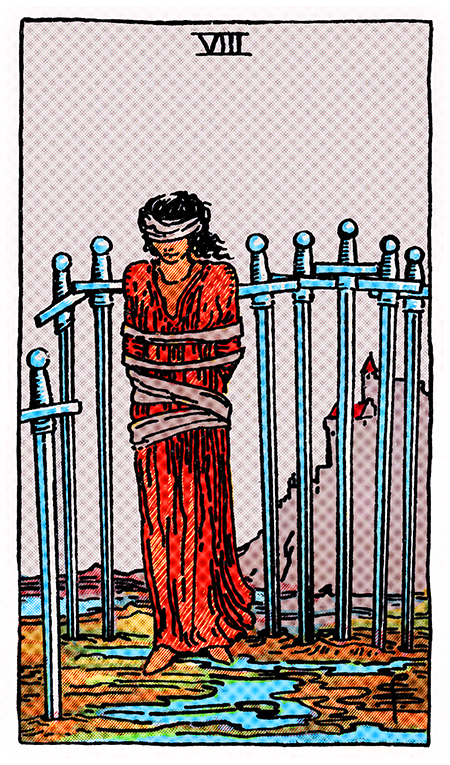 Eight of Swords
Air confined. The Eight of Swords is what happens when your thoughts build a cage and then convince you it’s made of steel. Your story feels real so the restriction feels real. “I can’t.” “There’s no way.” “This is just how it is.” But most of these bars are just assumptions or old beliefs that never got updated. This card is about the mental loop that keeps replaying the same conclusion and keeps you stuck in a quagmire of your own making, bound and certainly not moving forward despite the constant struggle.
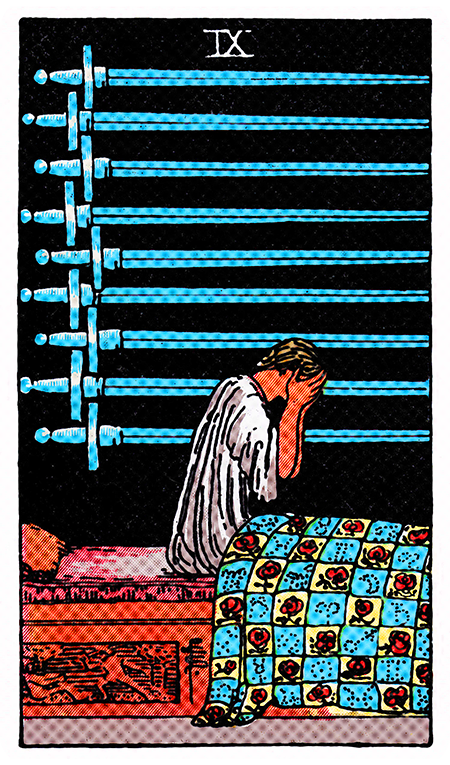 Nine of Swords
Air spiraling. The Nine of Swords is 3 a.m. energy. Everything feels louder in the dark. Lying there awake, the mind turns inward and starts amplifying fear. It replays conversations. Imagines outcomes. Builds entire disasters that may or may not quite be real. This is what happens when thoughts are unchallenged and unshared. Stressful situations are real, and they come with very real physical consequences that show up like panic attacks, a racing heartbeat, sweat, and tears (to name a few). The body will certainly keep score. But often what makes it unbearable is that we want to control what cannot be controlled. That desire (or demand) becomes an albatross, heavy and relentless, especially when you’re carrying it alone.
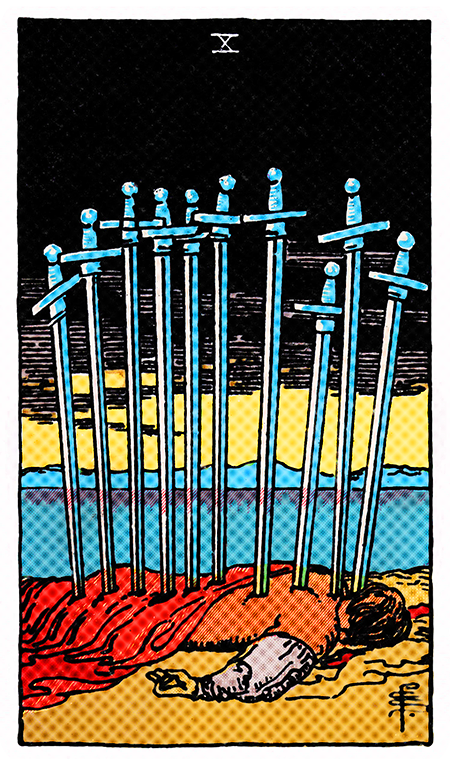 Ten of Swords
Air collapsed. The Ten of Swords feels dramatic. And sometimes it is. Something has ended. A belief. A version of you. A story you were clinging to. It feels final because it has peaked and you feel fully exhausted. There’s no more narrative left to spin. But here’s the quiet truth about this card: once you’ve faced the worst, there’s nothing left to imagine. And imagination is what fueled most of the fear to begin with.
The Court of Clouds
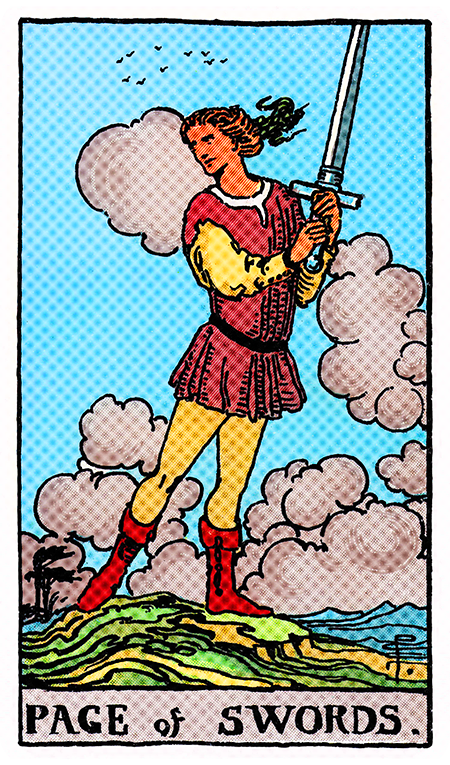 The Page of Swords
Air awakening. This is curiosity about ideas. The Page of Swords represents mental alertness, questions, and the hunger to understand. Thoughts are quick and energetic here. Observing. Listening. Testing.
Air at this stage is restless. It wants information. It wants to know what’s happening and why. Sometimes this curiosity becomes over-analysis or nervous chatter. The Page can jump to conclusions just as quickly as he discovers insight.
This card often shows up when you’re asking new questions. When you’re rethinking something you once accepted without challenge. When your mind feels active and alert, even if you’re not sure what to do with all that mental energy yet.
A great example of the Page of Swords would be Hermione Granger from Harry Potter. She is intellectually curious, always researching, always gathering information. But she's also quick to speak, quick to question. She's sometimes overly confident in her conclusions, but driven by a genuine desire to understand.
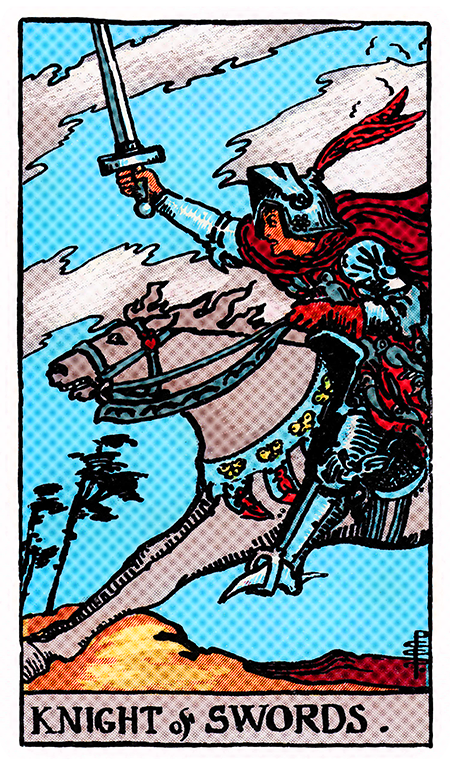 The Knight of Swords
Air pursuing. This is thought in motion. The Knight of Swords represents decisive action fueled by belief. Once he’s convinced of something, he moves. Quickly.
Air at this stage becomes forceful. Words are direct. Opinions are strong. There is little patience for hesitation. The Knight believes that clarity demands action.
At his best, he defends truth and cuts through nonsense. At his worst, he speaks before fully listening. Speed, here, often outruns wisdom.
This card appears when you feel compelled to say what needs to be said, when you’re ready to confront something directly. It can also be a reminder to slow down just enough to make sure your certainty is grounded.
A clear example of the Knight of Swords is Jon Snow from Game of Thrones: driven by principle; willing to act on what he believes is right. He's courageous and direct, but sometimes acting before considering the full political or emotional consequences.
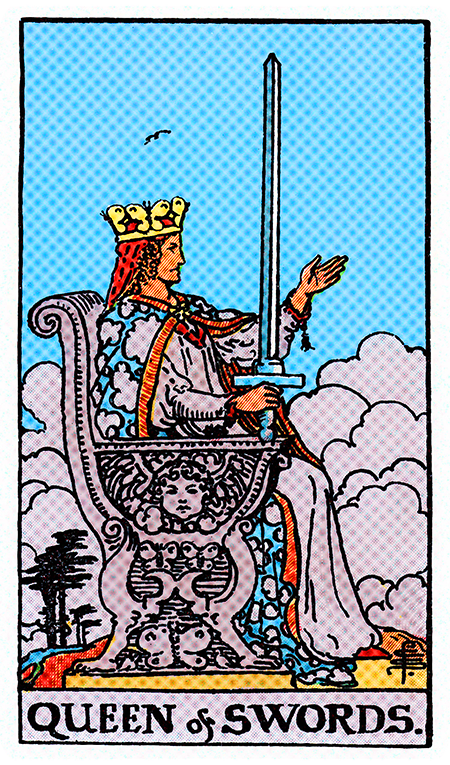 The Queen of Swords
Air refined. The Queen of Swords understands complexity. She sees through exaggeration and sentimentality. Her clarity is earned.
Air in the Queen is cool and perceptive. She listens carefully, then responds precisely. She does not fear difficult conversations. She has no problems whatsoever telling you how things are.
Of cousre this is not (necessarily) cruelty. It's what we'll call "discernment." She has learned that blurred lines create confusion. She's simply clarifying so there is no doubt.
The Queen of Swords often appears when you need to detach slightly from emotion in order to see a situation clearly. She reminds you that compassion and clarity are not opposites. They can coexist (she may just, occasionally, have a preference for one over the other).
A strong example of the Queen of Swords is Miranda Priestly from The Devil Wears Prada. She is perceptive, sharp, and emotionally self-contained. She expects competence, sees through excuses, and communicates without unnecessary softness. She may not be warm, but she is undeniably clear.
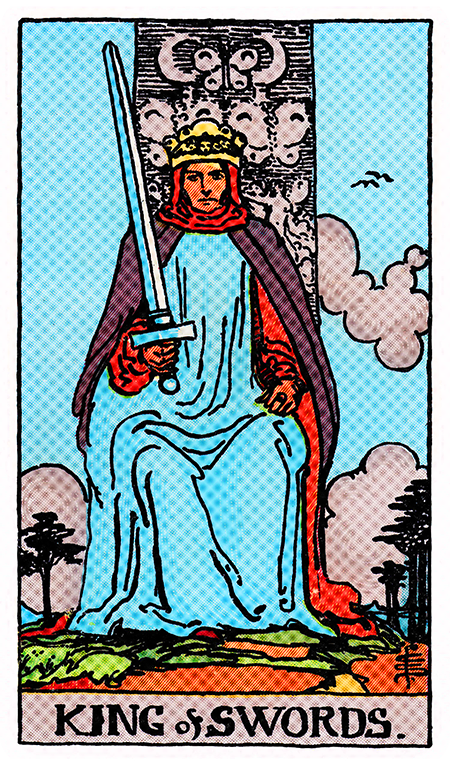 The King of Swords
Air mastered. The King of Swords represents intellectual authority. He does not simply react to ideas. He governs them.
Air at this stage is structured, intentional, maybe a little rigid. The King values logic, ethics, and principled decision-making. He wants consistency and fairness, or at least what he views as consistency and fairness.
This is the part of you that evaluates the bigger picture. That asks, “Is this aligned with what I know to be true?” He does not avoid emotion, but he refuses to let emotion distort judgment.
The King of Swords creates systems. He defines boundaries. He speaks with clarity and expects (sometimes demands) accountability.
A strong example of the King of Swords is Captain Jean-Luc Picard from Star Trek: The Next Generation. He leads through intellect, diplomacy, and ethical clarity. He listens carefully, considers the larger structure of a situation, and makes decisions grounded in principle rather than impulse.
When Air Becomes a Storm
We all know air is essential. We cannot live without it. And like water or fire, air is not neutral. When it isn’t balanced or examined, the same force that brings clarity and perspective can turn restless, sharp, or overwhelming.
The mind wants to interpret. It wants to define, analyze, and reach conclusions. But without awareness, thought can accelerate beyond reality. Then assumptions can harden into certainty. A single idea can gather speed until it feels undeniable. The atmosphere shifts, and it becomes harder to breathe clearly.
In the Suit of Swords, this can show up as overthinking, defensiveness, harsh self-criticism, or the need to prove oneself right. Too much air can mean anxiety, rigidity, or emotional detachment. This is where journaling becomes useful. Writing slows the mind down. It helps us separate fact from interpretation and gives perspective room to return.
That’s why some Swords cards deal with tension, betrayal, or mental exhaustion. The lesson isn’t to silence the mind. It’s to refine it. Air needs humility, flexibility, and reflection. Without those, clarity turns into coldness, intelligence turns into superiority, and conviction turns into control.

Swords is Mark Zuckerberg.
A great example of a modern King of Swords is Mark Zukerberg.
Mark Zuckerberg built one of the most powerful communication systems in modern history. His focus on structure, scale, and optimization reshaped how billions of people connect and share information. His impact literally reshaped social influence and communication.
But rapid growth and algorithmic efficiency often moved faster than reflection on human impact. The logic of expansion, engagement, and system design has now outpaced the emotional and social consequences of those systems.
This is the shadow side of air. When someone becomes convinced they’re right, everything else gets filtered through that certainty. Subtlety disappears. Listening slows down or stops altogether. The pace picks up, but at the cost of perspective.
It isn’t necessarily malicious. Sometimes it’s just momentum that has gone unchecked.
The lesson of Swords is not to abandon intelligence or innovation. It is to let thought be flexible. Air has to circulate and adjust. At its healthiest, the King of Swords leads with clarity and principle while remaining open to revision.
The Shifting Winds in the Suit of Swords
These details aren’t required to read Tarot well. You don’t need to memorize them or use them every time. They simply add texture and context to help you see the atmosphere more clearly.
Seasonally, the suit of Swords is often linked to winter. It’s a time when the air feels sharp and stripped back. Trees stand bare. Distraction falls away. Winter carries clarity, exposure, and truth. Just as the landscape is revealed without leaves, Swords invite us to examine what is real beneath our assumptions.
In traditional playing cards, Swords are connected to the suit of Spades. Spades often deal with challenge, strategy, and intellect. It’s another reminder that this suit is about thought and interpretation, not emotion or instinct. And yes, just like with Wands and Clubs or Cups and Hearts, you can read Spades in a standard deck if that’s what you have.
Zodiac Connections
Swords are associated with the air signs of the Zodiac: Gemini, Libra, and Aquarius. Each one reflects a different way air can show up mentally.
Gemini (May 21 – June 20) is connected to communication and curiosity. This is air that gathers information and moves quickly between ideas.
Libra (September 23 – October 22) represents balance, fairness, and perspective. This is air that weighs options and seeks equilibrium.
Aquarius (January 20 – February 18) is tied to innovation and independent thinking. This is air that challenges norms and sees systems from above.
Again, these connections aren’t rules. They’re simply another lens you can use if it feels helpful. Tarot works best when it stays flexible, personal, and responsive, just like air itself.
Final Thoughts on the Suit of Swords
Across the Suit of Swords, we see air at every stage, from the first breeze of clarity to the challenge of holding belief with maturity and balance. The court cards show how air expresses itself in human terms, from curiosity and conviction to discernment and principled leadership. The shadow side of Swords teaches us that thought without flexibility can become rigid, anxious, and isolating.
You don’t need to master every detail to work with this suit. What matters most is noticing how your thoughts are shaping your experience. The Suit of Swords doesn’t ask you to silence your mind. It asks you to examine it.