Pixel Tarot Blog
The Major Arcana: The Fool's Journey
A traditional Tarot deck is divided into two main parts: the Major Arcana and the Minor Arcana. Some modern decks change this structure by focusing only on the Major Arcana or by adding new suits, but most Tarot decks still follow the traditional format.
The Major Arcana is the part of the Tarot deck most people recognize. These are the cards you’ve probably seen in movies, TV shows, books, or on posters and t-shirts, like Death, The Hanged Man, or The Devil. Because they’re so visible (and often used out of context), they also tend to be the most misunderstood. But what makes the Major Arcana special isn't mystery or magic. It’s what these cards represent.
The Major Arcana is made up of 22 cards that focus on big life themes and important experiences. These cards don’t usually describe everyday events. Instead, they point to moments of change, growth, or understanding. The Minor Arcana, on the other hand, often reflects daily life, moods, and situations. For example, getting married might be seen as a Major Arcana moment, while going on a date or fighting with your family would fit more into the Minor Arcana.
But before we get into details of the Major Arcana, we need to understand how it came to be.
A Brief History of the Major Arcana
Tarot cards first appeared in Italy during the 1400s. The earliest decks were hand-made for wealthy families and were used to play card games, not for fortune-telling. These early decks looked a lot like regular playing cards but included an extra set of cards called trumps. These trumps later became what we now call the Major Arcana.
One early style of deck, used in a game called Tarocchi, included the familiar suits of Swords, Batons (now called Wands), Coins (now often called Pentacles), and Cups, along with trump cards.
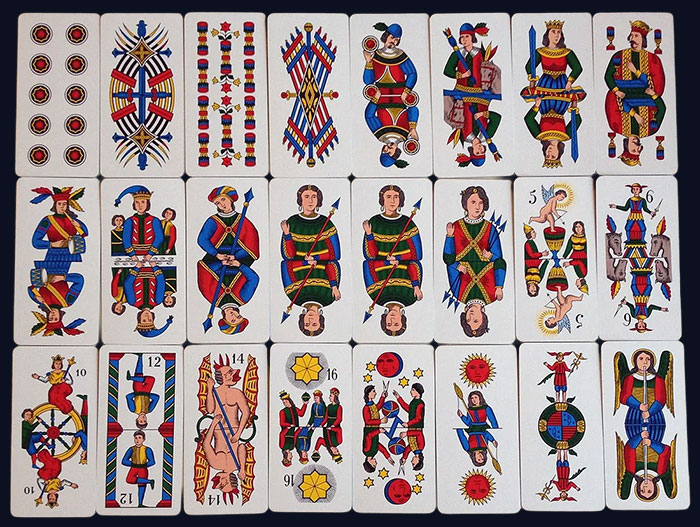
The oldest (almost) complete Tarot deck that still exists today was created in the mid-1400s in Milan, Italy for a wealthy family. It is currently on display at the Pinacoteca di Brera Museum in Milan. The deck included early versions of cards like The Emperor, The Hierophant, and The World. Even though the artwork looks different from modern decks, many of the ideas and symbols are still pretty easy to recognize.
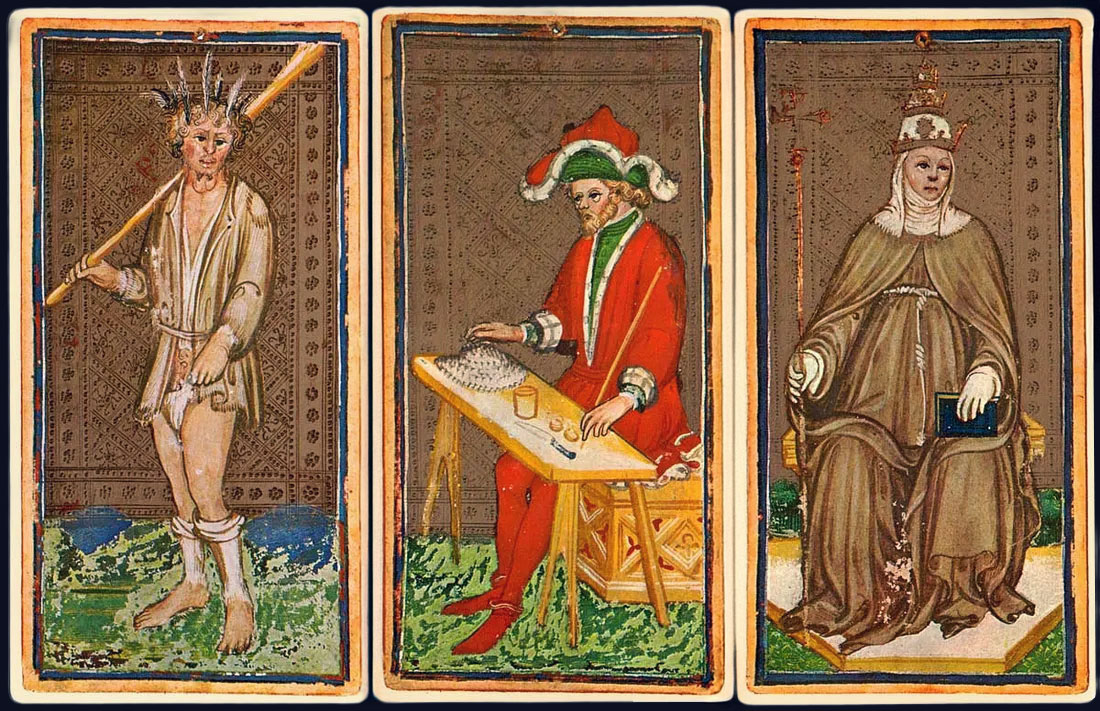
For hundreds of years, Tarot continued to be used as a card game under a variety of different names. That began to change in the late 1700s and early 1800s, when writers, scholars, and philosophers such as Antoine Court de Gébelin and Eliphas Levi, started to see the Major Arcana as a symbolic story about human life and personal growth. And while some of their historical understanding of Tarot we now know was incorrect, their work really contributed to the evolution of Tarot and its use as a tool for reflection and self-exploration.
The biggest change, however, came in the early 1900s with the Rider–Waite–Smith Tarot deck. This deck gave every card a detailed illustration (by the amazing Pamela Coleman Smith) and used consistent symbols across the deck. Because the images were now easier to understand and remember, Tarot became much easier to use and understand for the everyday reader.
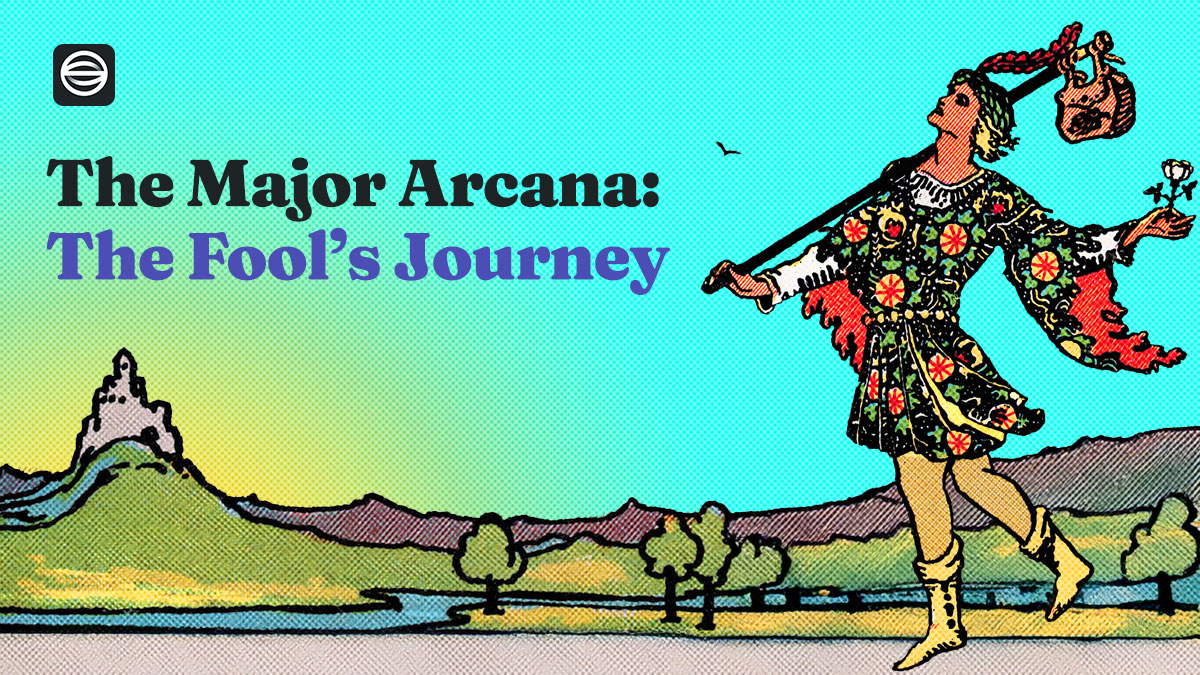
This deck also proposed the idea that the Major Arcana tells a connected story known as The Fool’s Journey. Instead of seeing the cards as separate meanings, they can be read as a series of loosely organized experiences that represent how people learn, struggle, grow, and make sense of their lives.
The Concept of The Fool’s Journey
The Major Arcana is often described as a story known as The Fool’s Journey. This journey begins with The Fool, the first card of the Major Arcana, numbered zero. The Fool represents a starting point, a moment of curiosity and possibility before anything is fully defined. As the cards progress, they tell a loose, symbolic story that walks through the experiences, lessons, and growth most people encounter in their life.
Rather than a direct set of steps, The Fool’s Journey is a way of understanding how people learn, change, and make sense of the world over time. While different versions exist, I like to view the journey as being divided into three phases, each made up of seven cards. None of these phases are explicitly procedural. The Fool can be between any of these cards at any time.
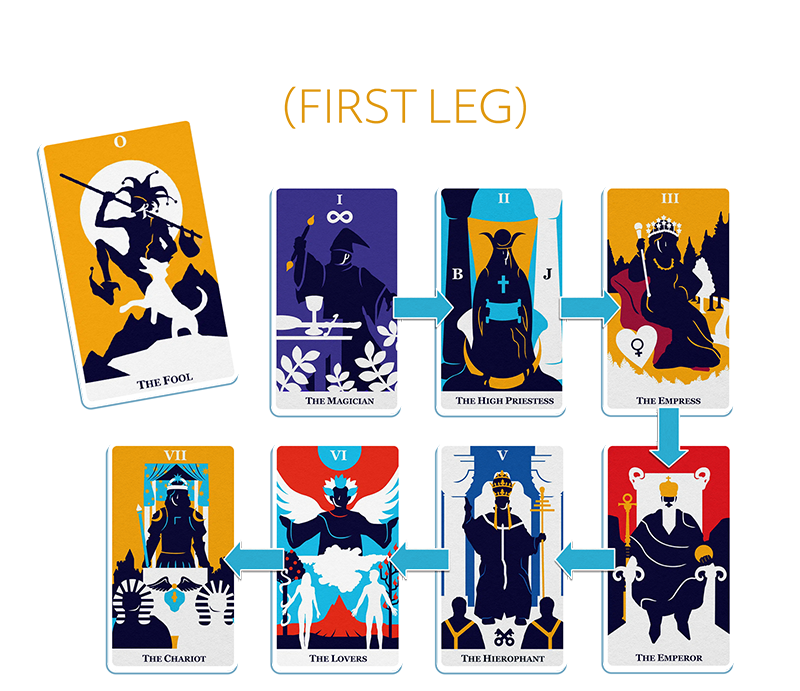
Phase 1: Learning the Rules (Who am I?)
The first phase of the journey focuses on learning how life works. This stage includes The Magician, The High Priestess, The Empress, The Emperor, The Hierophant, The Lovers, and The Chariot. These cards explore curiosity, learning new skills, forming beliefs, building confidence, and beginning to make independent choices. Together, they reflect early growth, (emotional and intellectual) as you start to understand yourself and your place in the world.
Another way to view the first phase of the Fool’s Journey is through physical and personal development, from conception to adulthood. The process begins with the spark of life and potential (The Magician), followed by slow, internal growth and gestation (The High Priestess). It continues through emotional nurturing (The Empress) and structure and discipline (The Emperor), moves into education and shared values (The Hierophant), early relationships and meaningful choices (The Lovers), and finally, the act of stepping out into the world on your own (The Chariot).
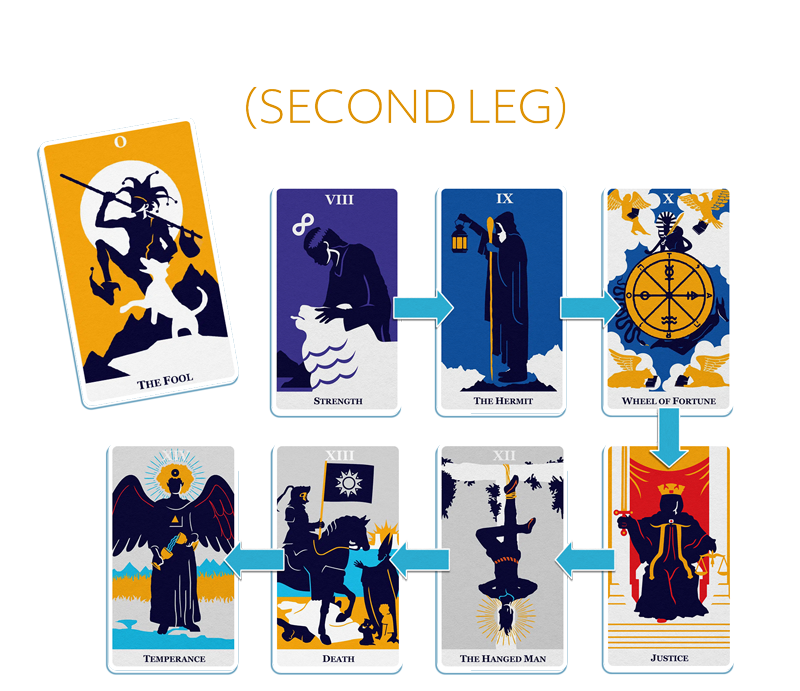
Phase 2: Learning the Hard Stuff (Why is this hard?)
The second phase is about facing challenges and change. This part of the journey includes Strength, The Hermit, The Wheel of Fortune, Justice, The Hanged Man, Death, and Temperance. Phase 2 is where the self meets other people, systems, and forces that don’t always behave the way we expect. These cards tend to show up when life becomes more complicated, such as setbacks, uncertainty, difficult decisions, and unexpected changes. The nuances of relationships, bias, and forced change are often seen here. But rather than see these as obstacles to avoid, these experiences help build resilience, perspective, and adaptability. This phase sees you developing relationships, making life-changing decisions, and setting us on a path for success (or failure).
Phase 3: Learning What It All Means (What does it all mean?)
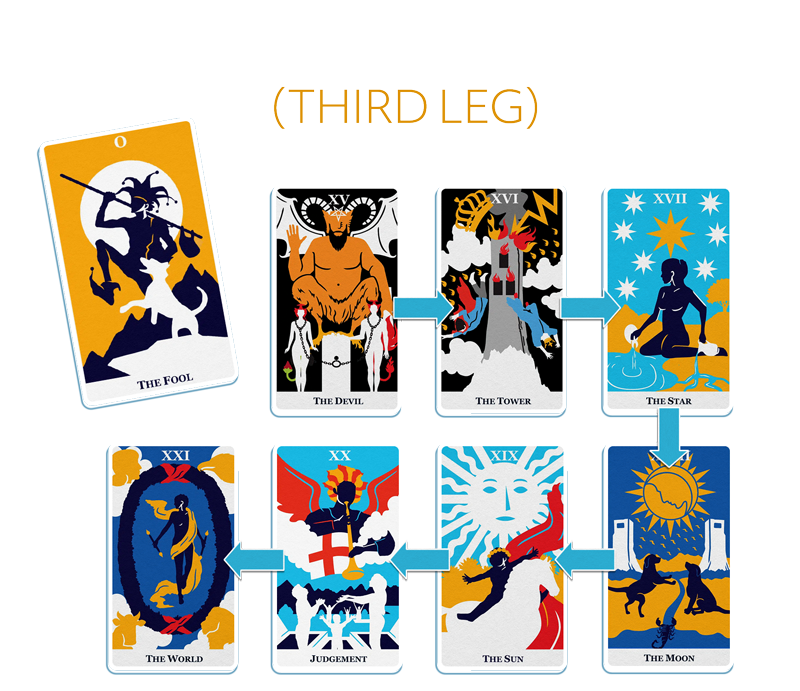
The final phase centers on understanding and reflection. It includes The Devil, The Tower, The Star, The Moon, The Sun, Judgement, and The World. These cards encourage looking inward, recognizing patterns, questioning assumptions, and gaining clarity. This phase is not about having all the answers, but about understanding yourself more fully and seeing how your experiences connect to a bigger picture. This phase sees us coming to terms with life and accepting the many lessons it's taught.
The Fool’s Journey offers a helpful framework for self-reflection and personal growth. Each card represents a different part of the human experience, and reflecting on them can encourage thoughtful questions rather than fixed conclusions. Like life itself, the journey doesn’t truly end. The Fool continues forward, always learning, changing, and beginning again.
The Major Arcana & Archetypes
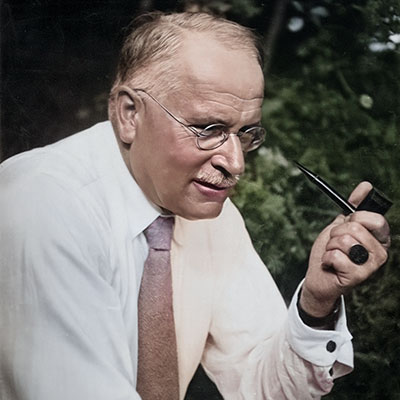 Psychologist Carl Jung (pronounced Yoong, with the oo sounding like the oo in 'book") introduced the idea of archetypes to describe patterns that show up again and again in human experience. He believed these patterns live deep in the human mind and influence how people think, feel, and behave. Jung referred to this shared layer of experience as the collective unconscious.
Archetypes are not specific characters or labels you’re supposed to memorize. Instead, they describe familiar roles or themes, like the hero, the teacher, the shadow, or the seeker. These ideas can be helpful when thinking about the Major Arcana, since those cards also focus on big, repeating life experiences.
While Jung himself did not connect archetypes directly to Tarot cards, many modern readers use archetypal language as a way to describe what the Major Arcana represents. In this way, each Major Arcana card can be seen as representing a common human role, challenge, or lesson. For example, The Magician is often associated with creativity, skill, and clever problem-solving (the archetype of the Creator or Trickster), while The High Priestess is commonly linked to intuition, inner knowledge, and paying attention to what isn’t immediately visible (the archetype of Intuition or Inner Wisdom).
Thinking in archetypes isn’t about labeling yourself. It’s about noticing which roles or lessons are asking for your attention right now.
Using the Major Arcana for Reflection and Readings
Because the Major Arcana focuses on big life themes, these cards can be especially helpful for daily reflection. Many people use them as daily card pulls or journaling prompts, choosing one card to think about throughout the day. Instead of predicting outcomes, the card offers a perspective to reflect on, helping you notice how certain themes may be showing up in your thoughts, actions, or experiences.
The Major Arcana can also be used alongside the rest of the Tarot deck to bring clarity to specific situations. Focusing on the theme of a card rather than taking it literally makes it easier to step back, see patterns, and gain insight without judgement. This can be especially useful when working with reversed cards, which are often read as blocked, internalized, or misunderstood versions of a card’s main idea.
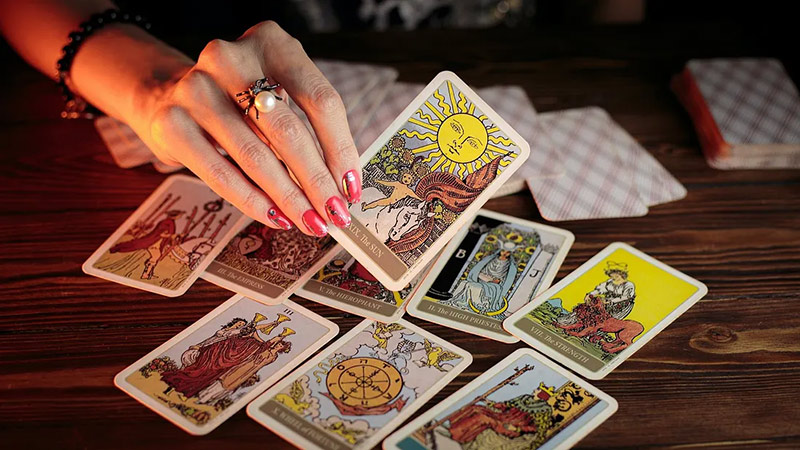
In a Tarot reading, Major Arcana cards tend to stand out. They often point to moments of importance, meaningful choices, or lessons worth paying attention to. When several Major Arcana cards appear in a reading, it may suggest that something significant is unfolding, not necessarily something dramatic, but something meaningful. Each reading is different, and personal intuition plays an important role in understanding how a card applies in that moment.
As you continue exploring Tarot, the Major Arcana can serve as a helpful guide for self-reflection and understanding. These cards don’t offer final answers. Instead, they encourage you to ask better questions, recognize patterns, and work through challenges with greater awareness. Like the Fool’s Journey itself, learning from the Major Arcana is an ongoing process, one that grows and changes as you do.
As you work with these cards, pay attention to which ones repeat, which ones make you uncomfortable, and which ones feel familiar. Those reactions are often where the real insight begins.